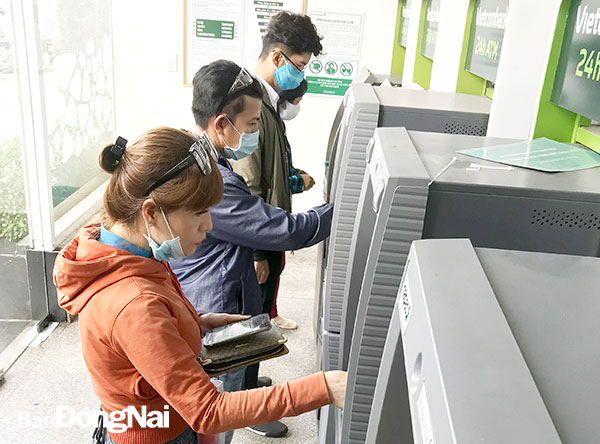
According to the State Bank of Vietnam (SBV), from March 31, 2021, banks will stop issuing magnetic ATM cards to convert to ATM chip cards, in order to increase convenience and security for customers. row. Talking to Dong Nai Newspaper’s reporter on this issue, Deputy Director of the State Bank of Vietnam, Dong Nai branch Pham Quoc Bao said, according to the roadmap to the end of 2021, there are 100% of bank cards and accepting devices. cards in Vietnam must be converted to chip standards. Currently, many banks are speeding up the card conversion process. * What is the difference between magnetic and chip cards? What is the purpose of this transformation? – Magnetic cards are made of plastic, containing a black or brown magnetic tape behind. This magnetic tape is responsible for storing the cardholder’s encrypted information. Information stored on the card is encrypted once and when swiped through a payment machine, information is decoded. However, devices that read and write cards can change the content of data on the card, and crooks can steal or change the user’s card information. Some popular types of magnetic cards such as ATM cards, time cards, parking lot access cards, elevator cards … A chip card is a card made of plastic but has an electronic chip in the front. This chip has a microprocessor like a miniature computer that operates independently, and important information is encrypted. The process of processing transactions on chip cards goes through many complicated steps, so it is highly secure. The conversion of domestic chip cards is an inevitable trend of countries in the region and internationally in the face of increasing high-tech crime and focusing on markets that have not yet implemented chip technology conversion. The conversion of magnetic cards to chip cards is aimed at increasing security and increasing convenience in card payments. This is also one of the key solutions of the banking industry. Thus, chip cards have many outstanding features compared to magnetic cards. Could you please analyze this more clearly? – Chip cards have 3 outstanding features, they are: safety and very high security compared to magnetic cards; optimized user experience; multi-utility, multi-application in non-cash payment. For security features for users, chip cards are manufactured according to the basic set of domestic chip card standards, which detail technical requirements for domestic payment cards in Vietnam according to technology. Contact and contactless chip, compatible with EMV standard (payment card according to alliance standard of card payment organizations in the world, with high security). The domestic chip card fully meets the technical factors of safety and security according to international standards, helps limit the risks of fraudulent fraud in card payment, ensures payment security and safety. customer. Due to its structural characteristics, magnetic cards can be easily stolen by fraudsters through stolen readers at ATMs and POS, thereby creating fake cards and transactions to steal money from cardholders. Meanwhile, chip cards use microchips to store card information instead of storing on the magnetic strip and only the issuing bank can read the data in the chip card, each transaction will have its own authentication code … This minimizes the theft of card information to create fake, fraudulent transactions. This is a superior safety and security feature compared to the magnetic card in use today. Feature optimized experience for users. There are two types of chip cards: contact chip cards – the cards that when the user wants to retrieve data, they have to be in physical contact with the card reader. This type of card offers better security but is slow to operate and requires contact. The contactless chip card – the card when used without direct contact with the card reader, just touch or place 2-10cm near the card reader device to be activated. This type of card makes transactions fast and avoids direct contact. In addition, chip cards also have very fast transaction speeds, only 0.2-0.3 seconds to complete a small value transaction. Multi-utility and multi-application feature in non-cash payment makes it convenient for users. Because chip cards store data, they can store more information fields than magnetic cards, so they can integrate non-cash service applications and means of payment with other industries such as transportation, insurance, and healthcare. , education and public service. In particular, the domestic chip card is optimally designed for payment in traffic with a normal transaction speed of 150-200mns, meeting the payment standard in public transport (below 300mns). * How is the card conversion prepared? When will the card conversion be completed, sir? – The Governor of the State Bank of Vietnam has instructed banks in the whole system to implement card conversion. It is expected that the time to stop issuing new cards will be from March 31, 2021. However, also for credit institutions can extend until the end of 2021 to complete compliance with chip standards for ATMs and card-accepting devices. But it is likely that many banks will finish soon.
On October 2020, according to the report of commercial banks, many banks have actively implemented the transition from magnetic cards to chip cards. Most banks already have the infrastructure and technology resources ready for converting all magnetic cards to chip cards of customers. Some banks have converted all ATM cards into chip cards. Is the operation of chip card transactions more difficult than with magnetic cards, sir? To secure their accounts, what should people pay attention to when using chip cards? – Chip cards have higher security features than magnetic cards, so in the first transactions, users have to go through many verification steps, although more complicated in manipulation, chip cards have transaction processing speed. It is very high for normal payments, so people do not worry about wasting time, especially contactless chip cards also allow faster payment operations. Chip cards are especially convenient for low value payments because there is no need for PIN authentication, so they are very convenient for payments at supermarkets, convenience stores, fast food restaurants, and coffee shops. .. Although chip cards have more security features, customers still need to be aware of protecting passwords, databases, personal information and accounts as recommended by the issuing bank to prevent crime. high technology aimed at me. In addition, users should pay attention to PIN security and not use predictable PINs; using balance notification services to control balance, control transactions; lock the card when there is no need to use it for a long time or when it is suspected that the card information is revealed; be cautious when performing card transactions such as checking ATMs, POS machines to see if the device has stolen PIN and not handing over your ATM card to others … * Thank you Sir. Source: http://www.baodongnai.com.vn/phongvan/202101/chuyen-doi-the-tu-sang-the-chip-gia-tang-tien-ich-va-bao-mat-cho-khach- hang-3037663 /
Other News

Why you need to use an ATM chip card ?
Increasing safety, high information security, minimizing the risk of fraud, stealing card information (skimming) … are the outstanding advantages that chip technology cards bring. Recently, banks have been offering ATM cards based on domestic VCCS card standards, complying with EMV international standards as well as increasing communication to their customers about this conversion. Why should
Details
Electronic payment with public services: Benefit both ways
Techcombank is a typical commercial bank going early and comprehensively, leading the promotion of electronic payment channels, increasing utilities for people. At the beginning of 2020, the Governor of the State Bank of Vietnam (SBV) issued Directive No. 01 / CT-NHNN requiring the banking industry to speed up non-cash payments, especially via bank payment for
Details
Cash withdrawal from credit cards via POS: It’s illegal and risky
Banks need to propagate to customers that credit cards cannot be used to withdraw money through short transactions, because it is illegal. Currently, cash withdrawal services from credit cards are very popular. Accordingly, there are a number of companies that have cooperated with banks to apply the Visa card payment channel to accept payment of
Details
Digital conversion must come with security risks
Banks are actively converting magnetic cards to chip cards, and it is expected to complete the conversion next year, according to the State Bank’s schedule. According to Mr. Nguyen Trong Duong, Deputy Director of Information Security Department (Ministry of Information and Communications), along with the explosion of technology 4.0, the gaps causing cybersecurity insecurity are
Details
Payment without cash: It is difficult for banks to transfer magnetic cards to chip cards
Chip cards enable local card issuers to expand their payment ecosystem into industries such as transport health and insurance. But banks say that converting magnetic cards to chip cards will incur additional costs. Converting domestic payment cards from magnetic cards to chip cards is one of the tasks approved by the Prime Minister in the
Details
No contact: Future banking trends
Vietnam has 41 banks with the current number of magnetic cards at about 75 million; nearly 280,000 POS machines – most of them have complied with the Chip Card Standard (EMV) and the upgrade to support the local chip card standard is not too complicated. Safety, security, multi utilities According to EMVCo data, as of
Details